Hungary: The Nation History Stole

On November 25th 1953 a football match between England and Hungary took place at Wembley Stadium. Hungary beat England 6-3 in what was dubbed "the match of the century." Nándor Hidegkuti scored a hat trick, Ferenc Puskás scored twice, and József Bozsik scored once. It was the first time England had ever lost on home soil.
Less than a year later Hungary invited England to Budapest to do it all over again. England left with a 7-1 defeat — their heaviest ever, a record that still stands to this day. Hungary were not just one of the best teams in the world. They were the best team in the world. They had won Olympic gold in 1952, had not lost a match since May 1950, and were dismantling some of the world's best teams in their own backyard.
Unfortunately this would be the peak of Hungarian football. Political upheaval and Soviet military force robbed this great nation of their destiny. A golden era lasting from 1938 to 1956, stripped away, never to return to those heights again.
This is the story of the Hungarian national football team — the nation history stole.
The Pre World Cup Era
Hungary first appeared at the Summer Olympics in 1912 in Stockholm, Sweden. They lost 7-0 to England in the first round and were eliminated — a heavy but not uncommon scoreline in an era when English football dominated the world game. What followed was telling. Later that same year Hungary travelled to Moscow and beat Russia twice — 9-0 and 12-0 — signalling that something was stirring.
In the 1920s Hungary employed a 2-3-5 formation, which was the standard shape of the era, but what set Hungary apart was how they interpreted it — with fluid movement and positional interchange that few other nations had yet discovered. It produced a brand of high scoring, attacking football that would become their trademark.
In 1924 they won their first Olympic games match, beating Poland, but fell in the second round to Egypt — a result that, while surprising, spoke to the unpredictable nature of football in this era.
Between 1927 and 1930 Hungary took part in the Central European Championship, considered to be the first international tournament of its kind. The competition consisted of Hungary, Italy, Austria, Czechoslovakia and Switzerland – the only teams to ever compete in the tournament. Over those four years the five teams played each other twice, with the team accumulating the most points winning the tournament. The final match, and the only one played in 1930, was between Italy and Hungary. Going into the game Austria and Czechoslovakia sat on 10 points apiece, with Italy and Hungary on 9 — meaning whoever won would claim the title. Unfortunately for Hungary, Italy won 5-0, with Giuseppe Meazza, considered the finest player in the world at the time, scoring a hat trick.

On June 27th 1927, Hungary beat France 13-1 in a friendly — a result that remains the largest victory in Hungarian football history. József Takács scored six goals in that match alone. These emphatic victories were becoming a staple of the Hungarian national team, and a clear signal that a new powerhouse was rising in world football.
The World Cup Era Begins
Hungary did not participate in the first World Cup in 1930, as the tournament operated on an invitation basis and Hungary were not among those selected. However, the Central European Championship continued to provide meaningful competitive football. In the 1931-1932 edition, Austria were leading the tournament, but Italy had the chance to leapfrog them by winning their final match against Czechoslovakia. Italy fell short however, losing 2-1, meaning Austria claimed the title. Hungary finished third on 8 points.
In the 1933-1935 edition, Italy and Hungary again found themselves meeting in the final match with the title on the line — a remarkable recurring dynamic across three consecutive tournaments. The match ended in a 2-2 draw, but Italy had accumulated enough points throughout the tournament to claim the title regardless. Hungary's György Sárosi finished as joint leading scorer alongside Czechoslovakia's Leopold Kielholz, both netting 7 goals. The first three editions of this tournament had clearly established a pattern — Italy and Austria had finished first and second in all three competitions, cementing themselves as the two dominant forces in European football at the time. Vittorio Pozzo's Italy and Austria's celebrated "Wunderteam" were widely regarded as the finest footballing nations in Europe, if not the world. Hungary, consistently finishing in the mix but unable to claim top spot, were emerging as the continent's most dangerous outsider.
The 1934 World Cup was the first edition in which nations were required to qualify, and Hungary successfully navigated that process. The tournament itself was a straight 16-team single elimination format. Hungary beat Egypt 4-2 in the first round — getting revenge for their shock second round exit to the same opposition at the 1924 Olympics — before unfortunately losing to Austria 2-1 in the quarter finals. It is worth noting that all five nations from the Central European Championship qualified for the tournament. The competitive experience those nations had accumulated playing each other in high-stakes matches proved vital. Italy went on to beat Czechoslovakia 2-1 in the final, claiming their first World Cup.
The next Central European Championship ran from 1936 to 1938, though it would never be completed. The tournament was abandoned following the annexation of Austria by Nazi Germany on March 12th 1938, bringing an abrupt end to one of European football's most compelling competitions. Hungary were sitting at the top of the table at the time of the abandonment. During the competition, on September 19th 1937, Hungary produced one of their most extraordinary performances, defeating Czechoslovakia 8-3. György Sárosi scored 7 of those goals — a record for a Hungarian player in a single match that still stands to this day.

Hungary again qualified for the 1938 World Cup. All four remaining nations from the Central European Championship also qualified, with Austria forced to withdraw following events earlier that year. The tournament was once again a 16-team single elimination format, and Hungary were devastating throughout. They dismantled the Dutch East Indies 6-0 in the first round, beat Switzerland 2-0 in the quarter finals, and then produced a stunning 5-1 victory over Sweden in the semi finals — one of the most emphatic semifinal wins in the tournament's history. For the first time ever, Hungary were going to a World Cup final.
Waiting for them in that final was Italy. Having lost to the Azzurri in two previous matches that effectively served as finals for the Central European Championship, Hungary were desperate to finally overcome their great rivals. The streak unfortunately continued — Italy won 4-2, claiming back-to-back World Cup titles under Vittorio Pozzo.
Yet there was genuine cause for optimism. György Sárosi, who had been Hungary's talisman throughout this entire era, was awarded the Bronze Ball — the prize given to the tournament's third best player. He had also scored in every single round of the tournament, an achievement that would not be matched for another 84 years until Lionel Messi replicated the feat at the 2022 World Cup in Qatar. He was 26 years old at the time. He had been the leading scorer of the abandoned 1936-1938 Central European Championship, and Hungary's squad was young, hungry, and improving with every tournament. Italy's ageing squad meanwhile appeared to be at its peak. All signs pointed to Hungary as heavy favourites for the next World Cup. Unfortunately for the Hungarians, history was about to strip that away.
The Tournaments That Never Were
In 1939 the world was plunged into the most devastating conflict in human history with the outbreak of World War II. Most footballing leagues across Europe were abandoned as their nations turned their attention towards the war effort. Italy was the notable exception — the Italian league continued until 1943, with Inter, Bologna, Roma and Torino all claiming titles during this period. Some national teams continued to play a handful of friendly matches against neighbouring nations, England playing against Wales 14 times and Scotland 15 times during the war years. But most nations played little to nothing during the conflict. Hungary are said to have played a small number of games during this period, though no official records of them exist.
With the war consuming Europe from 1939 onwards, the 1942 World Cup never happened. On August 13th 1936, at the 23rd FIFA Congress, Germany had formally applied to host the tournament — a stark reminder of just how differently the world expected the future to unfold. The timing could not have been crueller for Hungarian football. Just as Italy's dominant side of the 1930s was beginning to age and deteriorate, Hungary were emerging as the most dangerous force in European football. They were young, prolific, and improving with every passing year. They would have been among the very strongest favourites for a tournament that the war simply erased from history.
With World War II ending in 1945, FIFA made attempts to revive the World Cup in 1946, eager to restore some sense of normality to the world. But the devastation the war had left behind made it impossible. Many nations lacked the basic resources to travel and compete in an international tournament, and understandably chose to focus on rebuilding their countries and their communities rather than playing football. The 1946 World Cup never happened either.
While we have some sense of which nations might have competed for the 1942 title — with Hungary among the clear favourites — the would-be 1946 tournament is left more to the unknown. Nations had played so little football during the war years that form and quality were almost impossible to assess. If forced to make an educated guess, England and Italy would both have had reasonable claims — England had played 29 matches during the war years, and the Italian league had kept functioning longer than most. But the honest answer is that nobody knows.
What we do know is that Hungary lost eight years of their peak footballing era to the war. Eight years in which György Sárosi aged from 26 to 34. Eight years in which an entire generation of Hungarian footballers played in the shadows, unrecorded and uncelebrated. Sárosi himself never played for Hungary again after the 1938 World Cup final — the greatest stage of his career so far, became his final appearance in a Hungarian shirt, a bittersweet footnote to one of the most remarkable individual tournament performances the World Cup has ever seen. It is one of the most profound what-ifs in the history of the sport.
The Magical Magyars
While the 1946 World Cup never took place, the Central European Championship did make a comeback in 1948. This rendition of the tournament took place from 1948 to 1953 — tied for the longest edition of the tournament — and the original five nations were back again. This tournament served as the arrival of the iconic Ferenc Puskás, alongside the electrifying Sándor Kocsis. Hungary got off to a flying start in their first official match in almost a decade, beating Switzerland 7-4 with the then 21 year old Puskás scoring twice.
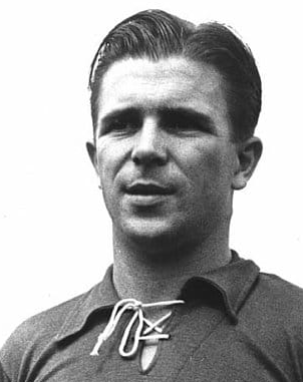

The tournament became a three horse race between Hungary, Czechoslovakia and Austria. Coming down to Hungary's last game, a win would put them beyond the reach of the Czechs, who still had two matches remaining, and would deliver Hungary their first official tournament championship. In poetic fashion, their final match was against the nation that had denied them three times before — Italy. On May 17th 1953, in front of 80,000 people at the Stadio Olimpico, Hungary defeated Italy 3-0, with Nándor Hidegkuti scoring once and Ferenc Puskás scoring twice. Hungary were finally champions. Puskás finished as the tournament's leading scorer with 10 goals, and Hungary were the tournament's leading scorers with 27 goals — no other team had managed more than 18. This would become a recurring theme for the Hungarians during this era.
The Central European Championship marked the beginning of the golden era of Hungarian football. Hungary would lose just once between 1950 and 1956, earning themselves the nickname the "Magical Magyars." On May 14th 1950, Hungary lost an international friendly to Austria — it would be their last defeat for four years.
While this was the greatest period in Hungarian football history, there is one significant blot on it. In 1950 the World Cup made its return for the first time in 12 years, being played in Brazil. But due to political tensions surrounding the Iron Curtain — the ideological divide that separated Soviet-controlled Eastern Europe from the Western world — Hungary, along with Czechoslovakia and the Soviet Union, chose not to participate in qualifying. This marked yet another World Cup in which Hungary had a genuine chance of winning, only for the opportunity to be taken from them. Uruguay went on to win the tournament, beating Brazil in a famous final.
The 1952 Summer Olympics were held in Finland, and Hungary were determined to prove themselves to nations beyond Europe. While the Olympics carried less prestige than the World Cup, it represented a genuine chance for Hungary to announce themselves to the world. They were utterly dominant throughout — beating Romania 2-1 in the preliminary round, dismantling Italy 3-0 in the round of 16, crushing Turkey 7-1 in the quarter finals, and then sweeping aside Sweden 6-0 in the semi finals. On August 2nd 1952 Hungary claimed their first Olympic gold medal in football, winning the final 2-0 against Yugoslavia. They had made their statement.
Following the Central European Championship title and the Olympic gold medal, Hungary were brimming with confidence and attracting the attention of the footballing world. But nothing would capture that attention quite like what happened on November 25th 1953. Hungary were set to face England at Wembley Stadium. England had never lost at Wembley. Hungary were 22 games unbeaten heading into the match. All signs pointed towards a captivating contest — but nothing could have prepared anyone for what followed.
Just 50 seconds into the match, Nándor Hidegkuti scored, catching the hosts completely by surprise. England equalised through Jackie Sewell in the 13th minute, before Hidegkuti restored Hungary's lead in the 20th minute. Then, in the 24th minute, Ferenc Puskás scored one of the most iconic goals ever witnessed at Wembley. Receiving the ball on the right hand side of the six yard box, with England's Billy Wright charging in with a slide tackle, Puskás beautifully dragged the ball back as Wright slid helplessly past, and fired it into the net. It is one of the main reasons FIFA later chose to name their annual award for the most beautiful goal of the calendar year after Puskás. Hungary ran out 6-3 winners, with Hidegkuti completing a hat trick, Puskás scoring twice and József Bozsik adding the sixth. The match was later dubbed "the match of the century."

The reaction from the England camp afterwards spoke volumes. Sir Bobby Robson later reflected — "We saw a style of play, a system of play that we had never seen before. None of these players meant anything to us. We didn't know about Puskás. All these fantastic players, they were men from Mars as far as we were concerned. They were coming to England, England had never been beaten at Wembley — this would be a 3-0, 4-0 maybe even 5-0 demolition of a small country who were just coming into European football." Robson would later add — "That one game alone changed our thinking. We thought we would demolish this team — England at Wembley, we are the masters, they are the pupils. It was absolutely the other way." This game fundamentally changed how England approached football, and many historians argue it laid the groundwork for their World Cup triumph in 1966.
Less than a year later, in May 1954, Hungary faced England again — this time in Budapest. England arrived looking for revenge. They left having suffered one of the heaviest defeats in their history, losing 7-1. These two matches against England announced Hungary to the world as one of the greatest teams ever assembled.
Heading into the 1954 World Cup, Hungary were the overwhelming favourites. And the data backs up just how justified that status was. The Magical Magyars played 69 matches between 1950 and 1956, winning 58, drawing 10 and losing just one. Using the modern Elo rating system that FIFA employs for their current rankings, Hungary on June 30th 1954 achieved the highest points total ever recorded — 2,231 points. For context, Spain currently sit top of the FIFA rankings in March 2026 with 1,877 points. Hungary's peak was in a different stratosphere entirely.
In 2016 the BBC, working with a supercomputer from Salford University, conducted an experiment in which teams throughout history were assessed based on results, goals scored, goals conceded and the strength of their opponents. The exercise generated a ranked top ten of the greatest national sides of all time. Teams such as France in 2000, Brazil in 1970 and Spain in 2010 all featured. The team ranked first? Hungary in 1954. The supercomputer concluded that Hungary at their peak represented the highest point in the history of international football.
1954 World Cup
The 1954 World Cup was played in Switzerland. On the back of their victories over England, Hungary entered the tournament as overwhelming favourites, with Uruguay and Austria also considered strong contenders. Based on the supercomputer and Elo rating system, the greatest national team of all time was ready for their crowning moment.
Hungary were placed in Group 2 alongside West Germany, South Korea and Turkey. They faced South Korea first and won 9-0 — the biggest victory in World Cup history at the time, a record that still stands today, tied with Hungary's own 10-1 victory over El Salvador in 1982 and Yugoslavia's 9-0 defeat of Zaire in 1974. Puskás scored twice in the match and Sándor Kocsis helped himself to a hat trick. In their second group game Hungary dismantled West Germany 8-3, with Kocsis scoring four goals — a defeat that remains the heaviest in West Germany's World Cup history to this day.
In the 1954 World Cup each team played only two group stage games, meaning Hungary never faced Turkey — and based on what Hungary had done to them at the 1952 Olympics, the Turks were more than comfortable with that arrangement. With Turkey and West Germany level on points, a playoff match was required to determine who would advance — goal difference was not yet used as a tiebreaker. West Germany won that playoff 7-2. Had goal difference been the tiebreaker, it would have been Turkey who advanced and West Germany who went home — a detail that makes everything that followed all the more remarkable.
In the quarter finals Hungary faced Brazil in what is now immortalised as the "Battle of Berne." Early in the second half Hungary were awarded a penalty which they converted to make it 3-1 — a decision that prompted a pitch invasion by Brazilian journalists and officials who believed the penalty was unjust. Police were forced to clear the pitch, but the chaos did not end there. A challenge from Nílton Santos on József Bozsik sparked a fight between the two players, resulting in both being sent off. After the final whistle the Brazilian players invaded the Hungarian dressing room, leading to a full brawl between the two squads. In total 42 free kicks and 2 penalties were awarded across the match, but Hungary still advanced. The Magical Magyars were renowned for their slick, modern football, but the Battle of Berne proved that in a scrappy, ill-tempered game they still had everything required to win.

In the semi finals Hungary faced the reigning champions Uruguay, a side containing what many believed to be the second best player in the world behind Puskás — Juan Alberto Schiaffino. Like many players from this era, Schiaffino remains largely unknown to modern fans, yet he had a remarkable career that deserves far greater recognition. The match was level at 2-2 after 90 minutes, and it was Sándor Kocsis — the man who had been scoring for Hungary throughout the entire tournament — who settled it in extra time, netting twice to send Hungary back to the World Cup final.
Hungary were to face West Germany — the very team they had already beaten 8-3 in the group stage. West Germany had fine players, but every indicator pointed towards a fairy tale ending for one of the greatest teams ever assembled. But as we have learned in the past with this game, football can be unforgiving, at times.
Puskás gave Hungary the lead in the 6th minute, with Zoltán Czibor making it 2-0 just two minutes later. West Germany hit back quickly — Max Morlock pulled one back in the 10th minute, and Helmut Rahn equalised in the 18th to make it 2-2. The game then settled into a tense stalemate with Hungary creating the majority of chances. Werner Kohlmeyer produced two goal line clearances in the 54th minute, and three minutes later a Kocsis header crashed against the crossbar. With six minutes remaining Rahn collected a loose clearance on the edge of the box, feinted past his marker and drove the ball hard and low past goalkeeper Grosics to give West Germany the lead. Two minutes later Puskás had the ball in the net — but the linesman's flag was raised for offside. The whistle blew shortly after, ending not just the match but the Magical Magyars' unbeaten run. In what is now known as the "Miracle of Bern" — a title that captures the disbelief felt across the footballing world — West Germany had defeated Hungary in the most stunning upset in World Cup final history.
The controversy did not end on the pitch. Many remain convinced to this day that Puskás was not offside for his disallowed equaliser. Beyond that, doping accusations have long surrounded the West German side. Several German players fell ill after the final, initially attributed to contaminated injections. The team physician Franz Loogen claimed in 2004 that the players had been injected with vitamin C. However in 2010 a study conducted at the University of Berlin challenged this account, with researchers hypothesising that the players had unknowingly been injected with Pervitin — methamphetamine. In 2013 the Süddeutsche Zeitung published details from the completed 800-page study, in which the research team stated that the use of amphetamines had become routine in German football from the late 1940s, and reaffirmed their claim that an unspecified number of the 1954 squad had received Pervitin injections. In an interview with Der Spiegel, lead researcher Eggers also alleged that the German Football Association had obstructed the research by refusing access to their archives. It should be noted that doping was not illegal in football in 1954 — FIFA did not introduce doping controls until 1966. The truth of what happened in those dressing rooms may never be fully known.
The entire world was left stunned. Hungary had been the best team in the tournament by some distance — they finished as the highest scoring side in a single World Cup with 27 goals, a record that still stands today. Puskás was awarded the Golden Ball and Kocsis the Silver Ball. Kocsis finished as the tournament's leading scorer with 11 goals — a record at the time and still second all time today, behind only Just Fontaine's 13 goals at the 1958 World Cup. Despite the heartbreak, Puskás was still only 27 years old and Kocsis just 24. Hungary had every reason to believe 1958 would be their year. But just as in 1938, political upheaval was about to take away their chance at redemption.
The Hungarian Uprising
Despite the heartbreak of 1954, Hungary showed remarkable resilience in the aftermath. They won five of their last six matches to close out the year, scoring four or more goals in every victory. As 1955 began, a new edition of the Central European Championship got underway — this time with Yugoslavia added to the mix. The tournament would run from 1955 to 1960 and would prove to be the last, as the modern European Championship began to take shape in 1960. Hungary drew 2-2 with Austria in their opening match but went on to win ten of their remaining eleven games that year, four of which came in the Central European Championship. It would prove to be the last great footballing year in Hungary's history.
On February 19th 1956, Hungary lost their first non-World Cup game in six years, falling 3-1 to Turkey in a friendly. They recovered briefly with a 4-1 win over Lebanon, but the bounce back was short-lived. Hungary went winless in their next four games — losing to Belgium and Czechoslovakia, drawing with Portugal and Yugoslavia — the first time they had gone four games without a win since 1940. They steadied somewhat, winning their last five games of the year. But by the end of 1956, their nation had changed forever.
On October 23rd, university students in Budapest began a peaceful protest outside the Hungarian parliament and at the Magyar Radio building. The students at the radio station presented demands for political and economic reform, free elections, and the withdrawal of Soviet troops — but their delegation was quickly detained by Soviet guards. When protestors outside demanded their release, police fatally shot several of the students. The killings triggered nationwide upheaval, with armed militias forming across the country to resist the authorities. The Soviet Union initially pulled back its forces, but on November 4th launched a full military invasion of Hungary, seizing the capital. Around 2,500 Hungarians were killed, approximately 200,000 fled the country, and a pro-Soviet government was reinstalled under János Kádár.
The consequences for Hungarian football were immediate and devastating. At the time of the uprising, Budapest Honvéd — the club side that served as the backbone of the national team — were abroad on a European Cup tie. Puskás and his teammates refused to return to the country. The refusal earned Puskás a two year worldwide ban from FIFA, and many believed his career was finished as he struggled to maintain his fitness during the suspension. History would prove otherwise. In 1958 Puskás signed for Real Madrid, where he rediscovered his brilliance and went on to win three European Cups, five Spanish league titles, and four Spanish League top scoring titles — one of the most remarkable second acts in footballing history.
Hungary's match against Austria on October 14th 1956 was the last time both Puskás and Kocsis wore a Hungarian shirt.
Here is a chart showing every player to have scored 75 or more international goals.

As you can see, Kocsis and Puskás have the fewest and third fewest appearances of anyone in that group. Had the Hungarian Uprising never happened, it is safe to assume that both would feature in the top ten international goalscorers of all time — if not the top five.
Many Hungarian players never represented their country again after 1956. Of the eleven players who started the 1954 World Cup final, only three played for Hungary at the 1958 World Cup. Hungary did qualify for the tournament but were eliminated in the group stage, winning just one match. A generation had been lost overnight.
Yet there was still one competition in which Hungary had a chance at something. Before the uprising, Hungary sat top of the Central European Championship with 12 points and two matches remaining. By the time they played again, Czechoslovakia had overtaken them with 14 points and one game left. In late 1959 Hungary beat Switzerland 8-0 to level the Czechs on 14 points, but Czechoslovakia then won their final match 2-1 to move to 16 points. With the tiebreaker in their favour, all Hungary needed was a win in their final game to claim back to back titles. Awaiting them, as so many times before, was Italy. And like so many times before, Hungary fell short — drawing 1-1 with the Azzurri. Czechoslovakia were crowned champions of the last ever Central European Championship. Hungary's greatest era had ended not with a triumph, but with the cruelest of familiar heartbreaks.
Footballs Greatest What if
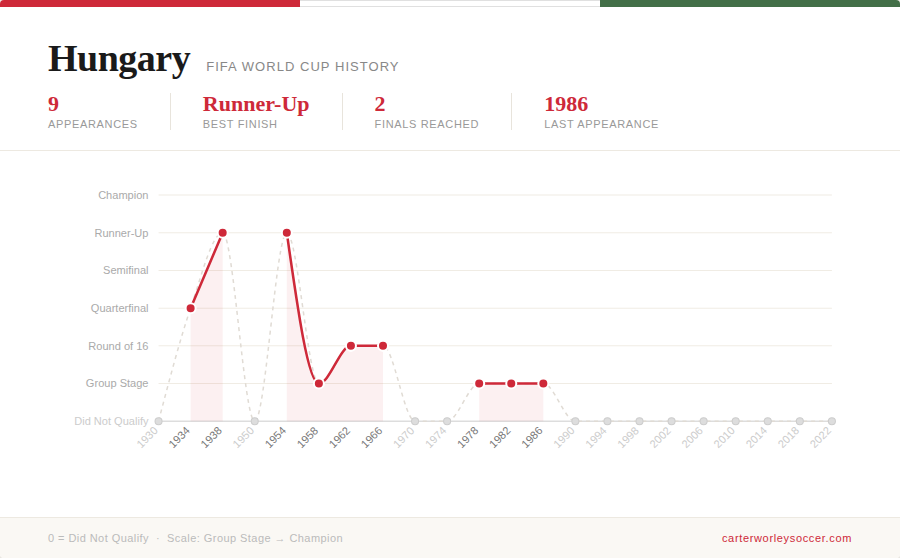
Today, Hungary remains a shadow of its former self. They have not qualified for the World Cup since 1986, and after reaching the final in 1954 never progressed beyond the Round of 16 again. Following the heartbreaking loss in the final and the devastation of the Hungarian Uprising, football gradually lost its grip on the national consciousness, with Hungarian society turning its focus increasingly towards academic and intellectual pursuits in the decades that followed.
The individual brilliance of that golden generation was recognised at the highest level. Puskás finished second in the Ballon d'Or in 1960, and Flórián Albert claimed the award outright in 1967 — but since Albert's win, no Hungarian player has come close to a top three finish. The greatest era of Hungarian football produced players who by any statistical measure rank among the finest the game has ever seen, yet the sport they helped define has never returned to Hungary in the same way.
Hungary had many what ifs throughout their history — the cancelled World Cups of 1942 and 1946, the political decision to skip 1950, the narrow defeat in 1954. But none will loom larger than this: had goal difference been used as the tiebreaker in the 1954 World Cup group stage, West Germany would have been eliminated before the knockout rounds ever began. It is worth noting that goal difference would not be introduced to the World Cup until 1970 — meaning that for sixteen years after 1954, the tournament continued to use playoff matches to separate level sides, the very rule that allowed West Germany to survive and advance. Hungary would almost certainly have faced Austria in the final — a team they beat 4-1 just months later. The greatest team in the history of football, according to both the Elo rating system and the BBC's supercomputer, would in all likelihood have been world champions.
Had things gone Hungary’s way throughout history, their World Cup results could look something like this.

A stark contrast to what actually happened.
I leave you with this. Here is a chart showing the goals scored by selected nations across the first five World Cups.

Goals are not everything. But they paint a picture. Hungary scored the second most goals of any nation across those five tournaments — despite only appearing in three of them. Since 1954, Hungary have scored just 40 goals across all their remaining World Cup appearances combined. The contrast is almost incomprehensible.
Before the Hungarian Uprising, Hungary were one of the great footballing nations on earth, and there was nothing on the horizon to suggest that would ever change. But history had other plans. Hungary would become, as this piece has tried to show, the nation history stole.


Comments