Using Numbers To Find The 100 Greatest Football Players Of All Time

Updated: Feb 24
In 2024 this image went viral on twitter, the media outlet “GDC Media” put together a list of what they believe to be the top 100 greatest footballers of all time.

However, this list went viral for all the wrong reasons. It faced a ton of backlash, with people heavily disagreeing with almost every aspect of the rankings. Football, being a highly subjective sport, sees people employing various criteria to assess how good a certain player is. So this got me to wonder: What if we stripped away as much bias as possible and compiled a top 100 list based solely on numbers? And so, that's exactly what I did. I created a top 100 list using only numbers.
Player Pool
Let's start with the player pool. I have taken the 100 players in the GDC Media list, along with an additional 155 players that I thought could have a shot at cracking the top 100. The additional 155 players are found below.

Here are 255 of the best players to have ever played, there are players like Gyorgy Orth who played in the 1910’s and players like Lamine Yamal, Erling Haaland and Vinicius Junior whose careers are just getting started.
Trophies/Awards
I have chosen 26 trophies and awards and given each of them what I believe to be a fair point value. I have tried to select trophies and awards that most if not all players had a chance to compete for. Awards like “FIFA’s The Best” and “UEFA Men’s Player of the Year” are not included as they are awards that have started in the last 5-15 years. Now this is going to get complicated, but let's start with the easy awards and trophies gauge.
Ballon d’Or: 75 Points
Second Place Ballon d’Or: 35 Points
Third Place Ballon d’Or: 20 Points
World Cup: 100 Points
World Cup Golden Ball: 50 Points
World Cup Silver Ball: 25 Points
World Cup Bronze Ball: 20 Points
World Cup Golden Boot/Golden Glove: 35 Points
Champions League/European Cup: 40 Points
UEFA Cup/Europa League/Copa Libertadores: 20 Points
Super Cup/Intercontinental Cup: 5 Points
European Golden Shoe: 10 Points
Champions League/European Cup Golden Boot: 10 Points
UEFA Cup/Europa League/Copa Libertadores Golden Boot: 5 Points
World Cup Team of the Tournament: 30 points
These categories are self-explanatory. Pele, for instance, has won 3 World Cups, earning him 100 points for each World Cup and thus totaling 300 points for his 3 World Cups. It's worth noting that the Golden, Silver, and Bronze Ball awards were officially introduced during the 1982 World Cup. However, football historian and analyst Ejikeme Ikwunze published a list of the Golden, Silver, and Bronze Ball winners for the World Cups spanning from 1930 to 1978 in his book 'World Cup (1930-2010): A Statistical Summary'. It's important to mention that former FIFA presidents and media outlets corroborate his list. Therefore, I allocated points to players who won these awards prior to the 1982 World Cup based on his list. Now let's get a little more complicated.
Each continent has its own secondary international competition compared to the world cup, so I have grouped the European Championship, Copa America, African Cup of Nations, CONCACAF Gold Cup, and the AFC Asian Cup all into the category of “Secondary International Trophy”.
Secondary International Trophy: 40 Points
Secondary International Trophy Best Player: 25 Points
Secondary International Trophy Golden Boot: 20 Points
Secondary International Trophy Team of the Tournament: 15 Points
Domestic league titles, domestic league cups, and domestic league golden boots are where things get tricky. Should someone get the same amount of points for winning the Premier League in the year 2010 as someone winning the Hungarian League in the 1930’s? I don’t think they should, so I have grouped domestic leagues into 2 groups.
The top group will consist of the top five European leagues (England, France, Germany, Italy, and Spain), along with the Argentine, Brazilian, Dutch, and Uruguayan leagues before the year 2000. Before the turn of the century, the Argentine, Brazilian, Dutch, and Uruguayan leagues were still seen as some of the best in the world. It wasn’t until the 2000s that the best players in the world began to move to the top five European leagues.
The bottom group will be the Argentine, Brazilian, Dutch, and Uruguayan league after the year 2000, along with every other domestic league to officially exist.
Top 5 European(Pre 2000 Argentine, Brazilian, Dutch, and Uruguayan) League: 20 Points
Non Top 5 European(Post 2000 Argentine, Brazilian, Dutch, and Uruguayan) League: 10 Points
Top 5 European(Pre 2000 Argentine, Brazilian, Dutch, and Uruguayan) League Cups: 10 Points
Non Top 5 European(Post 2000 Argentine, Brazilian, Dutch, and Uruguayan) League Cups: 5 Points
Top 5 European(Pre 2000 Argentine, Brazilian, Dutch, and Uruguayan) League Golden Boot: 15 Points
Non Top 5 European(Post 2000 Argentine, Brazilian, Dutch, and Uruguayan) League Golden Boot: 10 Points
Goals, Assists, & Clean Sheets
By far the trickiest aspect of this project was how to award appropriate points for goals, assists, and clean sheets, along with collecting accurate data for it.
For players who played before the year 2000, obtaining accurate data can be a bit tricky. Fortunately, I discovered a few Twitter/X pages that specialize in gathering very precise data for such players(Specifically those that played before the year 2000). I will include the links to the accounts I utilized at the end of the paper. However, these accounts and online websites were unable to provide assist data for a few dozen players. Therefore, I did my best to estimate assists using the partial data I had for some players and relied on written reviews of players' playing styles. Consequently, for some players, it's advisable to take their goals, assists, and clean sheets with a grain of salt and allow for a margin of 10-40 more or less for each.
The other challenging aspect of this process was determining how to allocate points for goals, assists, and clean sheets. Should a forward receive the same number of points for a goal as a defender? Clearly, they should not, so finding the right balance was difficult. I also had to ensure that the points awarded for these categories wouldn't overshadow or undervalue the points a player received from awards and trophies. While goals and assists are significant, they do not entirely define how good a player is. I aimed for the points earned from goals and assists to contribute about 40-50 percent of a player's total points. Fortunately, the average landed at 41%. Initially, I categorized players into semi-specific positions: forward, winger, attacking midfielder, center midfielder, outside back, center back, and goalkeeper. Then, I assigned specific points for goals and assists for each position
Forward: 0.3 points per goal
Forward: 0.75 points per assist
Winger: 0.7 points per goal
Winger: 0.75 points per assist
Attacking Midfielder: 1 point per goal
Attacking Midfielder: 0.75 points per assist
Center Midfielder: 1.2 points per goal
Center Midfielder: 0.75 points per assist
Outside Back: 2 points per goal
Outside Back: 1.5 points per assist
Center Back: 2 points per goal
Center Back: 2.25 points per assist
Goalkeeper: 0.95 points per clean sheet
Pre Ballon d’Or and South American Winners
Before the year 1995, only European players by nationality were eligible to win the award. However, in 2016, France Football conducted a reevaluation of previous winners and concluded that 12 out of the 39 Ballon d’Or recipients before 1995 should have been awarded to South American players. These players include Pele, Diego Maradona, Garrincha, Mario Kempes, and Romario. In my list, both the original and newly recognized winners will receive the points.
I should also note that the Ballon d’Or was not given out in 2020, but it is widely perceived that Robert Lewandowski would have won it that year, so I gave him the Ballon d’Or points for that year.
The Ballon d’Or was initially awarded in 1956. However, I sought a method to recognize players before 1956 for their excellence as the best player in the world. One of the accounts I utilized for data had compiled their own list of the best player in the world for each year, spanning from 1917 to the present day. This list was created based on the individual's personal opinion and references from newspapers regarding players' performances at the time. For the years 1917 to 1955, I allocated a certain number of points to the players chosen on this list. Although this approach introduces a degree of bias, I aimed to provide players who competed before the inception of the Ballon d’Or with an opportunity to earn points for their recognition as the best player of the year.
Pre Ballon d’Or Best Player in a Year: 30 Points
Here is that accounts list: https://twitter.com/AnamnesisF/status/1741518639365267537
The Top 100 Greatest Football Players Of All Time
100. Clarence Seedorf
99. Amancio
98. Teofilo Cubillas
97. Paul Breitner
96. Frank Rijkaard
95. Franco Baresi
94. Alessandro Del Piero
93. Juan Alberto Schiaffino
92. Zizinho
91. Ousmane Dembele
90. Jairzinho
89. Franck Ribery
88. David Beckham
87. Carlos Alberto
86. Peter Schmeichel
85. Rivellino
84. Charro Moreno
83. Mario Kempes
82. Kaka
81. Bastian Schweinsteiger
80. Paul Scholes
79. Deco
78. Andrea Prilo
77. Raul
76. Petr Cech
75. Samuel Eto’o
74. Raymond Kopa
73. Roberto Baggio
72. Mohamed Salah
71. Kenny Dalglish
70. Karl-Heinz Rummenigge
69. Sepp Maier
68. Hristo Stoichkov
67. Sadio Mane
66. Cesc Fabregas
65. Fernando Hierro
64. Phillipp Lahm
63. Arturo Vidal
62. Didi
61. Giuseppe Meazza
60. Sergio Busquets
59. Cafu
58. David Silva
57. Hector Scarone
56. Paolo Maldini
55. Frank Lampard
54. Marcelo
53. Enzo Francescoli
52. Ronald Koeman
51. Luis Figo
50. Arjen Robben
49. Paco Gento
48. Kevin De Bruyne
47. Ronaldinho
46. Luis Suarez(Spain)
45. Josef Bican
44. Thierry Henry
43. Ruud Gullit
42. Eusebio
41. Luis Suarez(Uruguay)
40. Ryan Giggs
39. Garrincha
38. Dino Zoff
37. Oliver Kahn
36. Zlatan Ibrahimovic
35. Sir Bobby Charlton
34. Daniel Passarella
33. Kylian Mbappe
32. Toni Kroos
31. Zinedine Zidane
30. Marco Van Basten
29. Lothar Matthaus
28. Karim Benzema
27. Angel Di Maria
26. Luka Modric
25. Rivaldo
24. Iker Casillas
23. Neymar
22. Sergio Ramos
21. Gianluigi Buffon
20. Roberto Carlos
19. Michel Platini
18. Thomas Muller
17. Andres Iniesta
16. Dani Alvez
15. Ferenc Puskas
14. Manuel Neuer
13. Xavi
12. Robert Lewandowski
11. Ronaldo
10. Romario
9. Gerd Muller
8. Alfredo Di Stefano
7. Zico
6. Johan Cruyff
5. Diego Maradona
4. Franz Beckenbauer
3. Cristiano Ronaldo
2. Pele
1. Lionel Messi
Who Missed Out?
First, let’s examine who missed out on the top 100 and determine why. The two most notable omissions to me are George Best and Lev Yashin. Best placing 128th with 543 points missing out on the top 100 by 54 points, while Yashin landed at 143rd with 497 points. For Best, it is quite straightforward to determine why he didn't make the top 100; having only 2 domestic league titles means he missed out on a significant number of points, and he also lacks notable achievements on the international stage, given that he is from Northern Ireland, which is relatively small in the footballing world. Similarly, it's evident why Yashin's numbers excluded him from the top 100; he spent his entire career in Russia, so the domestic leagues and cups he won didn’t gather him as many points as they would have in a more competitive league.
Now, I want to look at the list made by GDC Media and see how many players made their top 100 and didn’t make mine. Of their top 100 list, 29 of the players did not make mine, those players are:
David Villa: 103rd
Gareth Bale: 105th
Eden Hazard: 108th
Dennis Bergkamp: 109th
Steven Gerrard: 111th
Hugo Sanchez: 112th
Giacinto Facchetti: 113th
Paolo Rossi: 114th
Antoine Griezmann: 117th
Sandor Kocsis: 121st
Gheorghe Hagi: 123rd
Mesut Ozil: 124th
Alessandro Mazzola: 127th
George Best: 128th
Michael Laudrup: 129th
Jose Nasazzi: 134th
Francesco Totti: 142nd
Lev Yashin: 143rd
Sergio Aguero: 145th
Dejan Savicevic: 151st
Diego Forlan: 165th
Fabio Cannavaro: 168th
Riquelme: 172nd
Johan Neeskens: 187th
Virgil Van Dijk: 197th
Elias Figueroa: 215th
George Weah: 221st
Bobby Moore: 229th
Radamel Falcao: 245th
The highest-ranked player on their list who didn't make mine is Jose Nasazzi, who was ranked 25th on theirs and 134th on mine. That’s a difference of 109 places. How was he ranked 25th on their list yet 30 places away from making my top 100? Firstly, as a center back with few goals and assists to his name, he wasn't able to gather many points through offensive contributions. Additionally, he didn't win many domestic league titles. So, how did he end up 25th on their list? Well, he is arguably one of the best defenders, if not the best, in the history of the Copa America. He also won the very first Golden Ball. Nasazzi, alongside Hector Scarone and Angel Romano, hold the record with 7 trophies in their international careers, including 4 Copa America titles, 1 World Cup, and 2 Olympic Gold Medals—all three players represented Uruguay. I didn't include Olympic Gold Medals as a criterion because professional football players didn't prioritize participating in the Olympics starting in the 1940s and 1950s.
While Nasazzi has a difference in 109 places between my list and their list, that is not the biggest difference for a player.
George Weah was placed 76th on their list, while placing 221st on mine, finishing with a difference of 145
Bobby Moore was placed 75th on their list, while placing 229th on mine, finishing with a difference of 154
But the biggest difference goes to Radamel Falcao, who was placed 74th on their list, while placing 245th on mine, finishing with a difference of 171
Who Did GDC Media Miss
So with 29 players moving out of the top 100 that leaves room for 29 players who they did not have, to move into my list. Those players are:
Oliver Kahn
Josef Bican
Luis Figo
Hector Scarone
David Silva
Sergio Busquets
Fernando Hierro
Cesc Fabregas
Sadio Mane
Hristo Stoichkov
Sepp Maier
Karl-Heinz Rummenigge
Kenny Dalglish
Mohamed Salah
Roberto Baggio
Raymond Kopa
Samuel Eto’o
Petr Cech
Raul
Deco
Bastian Schweinsteiger
Peter Schmeichel
Carlos Alberto
Franck Ribery
Ousmane Dembele
Zizinho
Frank Rijkaard
Paul Breitner
Amancio
Clarence Seedorf
Oliver Kahn is the highest placed player in my list that was not in theirs, placing 37th. I don’t know how they didn’t include Oliver Kahn as he is the only goalkeeper to win the Golden Ball at the World Cup, that along with the 8 Bundesliga titles and 1 Champions League is why Kahn ended up 33rd.
How Oliver Kahn, Roberto Baggio, Karl-Heinz Rummenigge, Luis Figo, and Raymond Kopa didn’t make their top 100 but the likes of Radamel Falcao, Virgil Van Dijk, Sergio Aguero, and Antoine Griezmann did, is puzzling in my personal opinion.
Maybe GDC Media Was Right?
A lot of people criticized the GDC Media list and put their own suggestions of players who should be in, instead. While there were some relatively obvious ones they missed, based on my list they did get some right.
Wayne Rooney and Jimmy Greaves were 2 of the most popular players that people online said should have made the list but based on the numbers Wayne Rooney finished 144th and Jimmy Greaves finished 150th, so GDC Media was right not to include them.
Names like Drogba, Zanetti, Shearer, Kane, Terry, Ferdinand, and Vidic were some other names people online thought should be in the top 100, but based on the numbers GDC Media got right.
When I first looked at this list, Arturo Vidal's presence immediately caught my attention. He became the focal point of discussions surrounding the list, and it was almost unanimously agreed upon online that he shouldn't be included among the top 100 greatest football players of all time—a sentiment I shared. However, for all the things wrong with GDC Media's list, this was perhaps the one thing they got the most right, albeit partially. In their list, Arturo Vidal was placed 80th, whereas in my list based on numbers, Vidal stood at 63rd. However, despite the numerical ranking placing Vidal at 63, he shouldn't have even been considered for this list in the first place. Although Vidal had a commendable career and performed well, particularly during his time at Juventus and his initial tenure at Bayern Munich, at the club level outside of these periods, he often served as a borderline starter or squad rotation player. While he excelled for Chile during their triumphs in the 2 Copa America tournaments, he wasn't the standout player on either occasion; both Alexis Sanchez and Eduardo Vargas outshone Vidal during Chile's 2015 and 2016 Copa America victories. So how did Vidal end up finishing 63rd then? Well, for starters, he has the 2 Copa America wins, nine top 5 European League titles, along with the Copa Libertadores he won in 2022, and the points he accrued from goals and assists. This was enough to secure him the 63rd spot. However, when considering the context, it becomes apparent why people online had such a problem with him being included in the top 100.
What Is the Greatest Footballing Nation
Here is a chart showing the nationality representation in the 100:

It's not particularly surprising Brazil tops the list, given their rich footballing history. However Spain being second is interesting as they had never made it past the quarter finals in the world cup before their 2010 World Cup Triumph. Additionally, it’s worth noting that 11 nationalities have more than 1 player in the top 100.
Club Representation
Here is a chart showing the club representation in the top 100:

It should be noted that when assigning a club to a player, I chose the club they are most known for playing for. For some players, such as Zidane and Neymar, for example, the decision was particularly close. In such cases, I opted for the club for which the player had played more games. Interestingly, Real Madrid, Barcelona, Bayern Munich, and AC Milan collectively account for about half of the top 100. Additionally, it’s worth noting that there are 16 clubs that have more than one player in the top 100.
League Representation
Here is a chart showing the league representation in the top 100:

The Bundesliga boasts the fourth highest number of players in the top 100, all of whom played for a single team: Bayern Munich. 75% of the top 100 played in La Liga, Serie A, English League, and Bundesliga.
Positional Representation
Here is a chart showing the positional representation in the top 100:

It’s not particularly surprising that forwards take up nearly ⅓ of the top 100 but what is interesting is that of the 5 outside backs in the top 100, four of them are brazilian, that being Cafu, Dani Alves, Marcelo, and Roberto Carlos, the other outside back is Phillipp Lahm.
Decade Representation
Here is a chart showing the decade representation in the top 100:
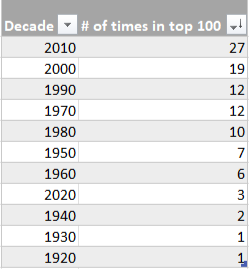
It should be noted that when assessing which decade a player was assigned to, I chose the decade in which they had the most success. While Ronaldo and Messi had great success in the 2000s and 2020s, their peak was the 2010s. Forty-six percent of the players in the top 100 have emerged since the turn of the century. The main reason for that is the availability of more accurate data, along with the addition of more competitions. While the top 10 is very diverse, featuring players from the 1950s, 60s, 70s, 80s, 90s, and 2010s, positions 11 through 28 include only three players from before the turn of the century (Ferenc Puskás, Michel Platini, and Rivaldo).
Positional Alternatives
There are a few players in the pool of 255 who played multiple positions throughout their careers. When I categorized the players by positions, I placed them in the position in which they played the most. However, there are a few players who could have been grouped into a different position. Let's explore where they would have been placed if I had opted for the alternative position.
Ronald Koeman: Ronald Koeman posed the greatest challenge in categorization due to his extensive experience in both center back and center midfield positions. While he played slightly more games as a center back, I chose to categorize him as a center midfielder to more accurately represent him in the top 100 list. He secured the 52nd spot with 752 points, which I find to be fair from a personal perspective. However, what makes Koeman particularly intriguing is his remarkable goal-scoring record despite primarily operating as a center back or center midfielder throughout his career. With approximately 251 goals to his name, categorizing him as a center back catapults him to the 14th position with 1096 points, placing him ahead of players like Platini, and Puskas. The possibility of Ronald Koeman being ranked as the 14th best player of all time highlights the limitations of ranking players solely based on numbers.
Carlos Alberto: Another player that posed a challenge in position categorization was Carlos Alberto as he is almost dead split at games played at right back and at center back. I have him categorized as a center back where he was placed 87th with 622 points. However, if I categorized him as an outside back he would have placed 108th with 569 points.
Sir Bobby Charlton: The final player who presented a challenge in position categorization was Sir Bobby Charlton. He placed 38th with 805 points, as I categorized him as an attacking midfielder. While I could have classified him as a forward, his position leaned closer to that of an attacking midfielder. If I had chosen to categorize him as a forward, he would have been ranked 79th with 641 points.
These Players Are to Low
There are some players rankings on this list that the general public would say are way too low. Let's take a look at some of those players and try and figure out why they aren’t as high as they should be.
Zinedine Zidane: Zidane's ranking at 31st may indeed seem perplexing, considering his stature as arguably a top 10 player of all time. However, several factors contributed to his placement. Firstly, his relatively low tally of league titles, just 3, compared to players ranked above him, is a notable factor. This aspect may have affected his points tally. Additionally, Zidane's career was somewhat shorter than some of his peers. While he spent 14 years at the top level of football, only 10 of those years were at the elite level, particularly during his time with Juventus and Real Madrid. These factors, combined, could explain why he landed at 34th place despite his undeniable talent and impact on the game.
Ronaldinho: Ronaldinho's placement at the 47th spot is widely perceived as too low, as the general public considers him to be among the top 20 or 25 players of all time. While personally, I may not rate Ronaldinho as highly as the general public does, I agree that 49th is too low for him. Similar to Zidane, one factor contributing to his lower ranking is his relatively modest tally of league titles, with only 4 in the top group (Noticing a trend?). Additionally, Ronaldinho's ranking was impacted by him winning only one Golden Boot award in all competitions. This is largely because Ronaldinho excelled in providing assists, for which there were no specific awards included in this project. Furthermore, like Zidane, Ronaldinho had a relatively short career, spending about 10 years at the top level and only approximately 5 to 8 years at the elite level.
Paolo Maldini: When I embarked on this project, I anticipated that Paolo Maldini would end up ranked too low. Widely regarded as the second-best defender of all time and a top 15 player overall, Maldini landed at 56th place with 727 points. This ranking is primarily due to his lack of goals and assists compared to other players. Additionally, Maldini's absence of a World Cup or European Championship title, as he retired before Italy's triumph in 2006, affected his points tally. Despite having the third-most caps at the World Cup, behind only Lothar Matthaus and Lionel Messi he never won it. Maldini's 56th position highlights a significant flaw in creating lists based solely on numerical data. Defensive ability, in which Maldini excelled arguably better than anyone else, lacks an analytical number to quantify it. Consequently, the top 100 list may be somewhat biased towards offensive players due to the absence of a metric for defensive ability.
Giuseppe Meazza: Giuseppe Meazza might not be a familiar name to many, and truthfully, before researching for this project, I was unfamiliar with him as well. As he played in the 1930s and 40s. However, upon delving into his career, it becomes evident why GDC Media ranked him 31st. Meazza, ranked 61st with 701 points on my list, but I personally believe he deserves a place among the top 50, perhaps even the top 40 players of all time. One factor contributing to his lower ranking is that he played in the 1930s, a time before the inception of the Ballon d'Or and the European Cup. Had these prestigious awards and competitions been established during his era, I believe Meazza would have been a multiple-time winner of both. Additionally, you guessed it, his relatively modest tally of only 3 league titles and 1 league cup contribute to his lower ranking.
These Players Are to High
As there are some players rankings on this list that the general public would say are too low, there are equally some players rankings that the general public would say are too high. Let’s take a look at some of those players and try and figure out why they are as high as they are.
Dani Alves: Dani Alves ended up being ranked 16th with 1072 points. While Alves is undeniably a very good player and deserving of a spot in the top 100, I personally believe 16th place is too high for him. I would place him somewhere in the 40-60 range. However, several factors contributed to his high placement. Firstly, Dani Alves boasts the second most trophies in the history of football, a feat only recently surpassed by Lionel Messi. He amassed an impressive 10 league titles, 14 league cups, and 3 Champions League titles. Additionally, Alves won the Copa America Best Player award in 2019. One of the best ways to assess a player's quality using numbers is by examining their trophy haul. Alves's significant number of trophies, coupled with his strong assist record, are the main reasons why he ended up ranking 16th.
Robert Lewandowski: When reviewing responses to the list compiled by GDC Media, I noticed a considerable number of people online expressing the opinion that Robert Lewandowski was ranked too high. On their list, he was placed 52nd, whereas he ranked 12th on mine. Personally, I disagree with those who believe Lewandowski was ranked too high; in fact, I think 52nd is a bit too low. I believe he should be placed somewhere in the 40s. The season he had in 2019-20 was truly remarkable, and he would have undoubtedly won the Ballon d’Or by a landslide if it had been awarded. Also, people tend to overlook his incredible feat of scoring five goals in just nine minutes against Wolfsburg, a moment considered among the greatest in football history. But why did Lewandowski end up 12th on my list? Firstly, since the 2009-10 season, he has won his respective league title every season except for 2012-13, 2013-14, and 2023-24. Additionally, he has secured 11 league golden boots, with 8 of them being in the top group. He is also one of only six players to have won a domestic league golden boot, a Champions League/European Cup golden boot, and a European Shoe. The other five players are Lionel Messi, Cristiano Ronaldo, Gerd Muller, Marco Van Basten, and Erling Haaland. Lastly, out of the 255 players I collected data for, he ranks 6th in terms of goals scored. Given that I only collected data for 255 players, I suspect Lewandowski is among the top 10 all-time leading goal scorers. Therefore, considering the number of league titles and golden boots Lewandowski has earned, along with his remarkable goal-scoring record, it's clear why he is ranked 12th all-time based on the numbers.
Thomas Muller: Thomas Muller is one of the most underrated players of all time, it is not surprising to me at all that he is 18th based on the numbers. He has won just about everything there is to win in football, plus he was a part of the Bayern Munich dynasty in the 2010’s. Gerd Muller and Paolo Rossi are the only other players in history to win the World Cup, World Cup Golden Boot, and the Champions League/European Cup. He’s one of 7 players to win at least 8 domestic league titles, 1 Champions League/European Cup and be included in a World Cup Team of the Tournament. He’s the only player ever to win the World Cup, World Cup Golden Boot, and win at least 7 league titles. I can do this all day but you get the point, Thomas Muller is, and should be, considered one of the greats.
Manuel Neuer: While Manuel Neuer is considered one of, if not the best, goalkeepers of all time, there is little doubt that 14th is too high a ranking for him. The reasoning behind his 14th-place placement is similar to Müller’s, in that he was a key part of the Bayern Munich dynasty that saw him win 12 titles in 13 years. Neuer also won the World Cup and the Golden Glove in 2014. He is one of only six goalkeepers to finish on the podium for the Ballon d’Or, with Lev Yashin, Dino Zoff, Ivo Viktor, Oliver Kahn, and Gianluigi Buffon being the others. This, along with his longevity in the game, explains his outstanding 14th-place ranking.
Ousmane Dembele: Ousmane Dembélé is arguably the most interesting case in the top 100. He is not one of the 100 greatest players of all time—at least not yet. However, being part of trophy-winning Barcelona and PSG teams, featuring in France’s 2018 World Cup–winning squad, and pairing that with an exceptional Ballon d’Or campaign last year is enough to earn him a place in the top 100. While he is not a top-100 player in terms of legacy right now, a strong World Cup campaign and a leading role in another French victory could spark conversations many fans are not ready for.
Angel Di Maria: Angel Di Maria emerged as the most discussed player online in response to GDC Media's list. I, along with many others, found his 17th place ranking to be incredibly too high. It's simply inconceivable to assert that Angel Di Maria surpasses the likes of Andrés Iniesta, Luka Modric, and Ferenc Puskas. In my view, the general consensus would place Di Maria as a borderline top 100 player, likely making everyone's list towards the bottom spots. Anything higher than 75 would seem excessively generous. However, despite these reservations, he secured the 27th position with 954 points. Di Maria's trophy cabinet includes 8 domestic league titles, 1 Champions League triumph, 1 World Cup victory, and 2 Copa America triumphs. Additionally, his commendable assist statistics contributed to his ranking at 27th place based on the numbers.
Ronaldo vs Messi
The Ronaldo vs Messi debate is well and truly settled, Messi has had the better career, simple. But I want to go back a few years, before Messi won the Copa America and the World Cup and see how close the debate was. I am of the opinion that Messi’s Copa America win in 2021 actually swung the pendulum back in his direction, so let’s see what the numbers say. I have altered Messi and Ronaldo’s stats to reflect what they were before the Copa America in 2021, let’s see how close they were before the Copa America, based on the numbers.
Lionel Messi: 2051
Cristiano Ronaldo: 1776
Albeit closer than it is now, Lionel Messi was already greater than Ronaldo based on the numbers, even before winning the Copa América and the World Cup. His two Copa América titles and World Cup victory did, in fact, see Messi overtake Pelé as the greatest of all time.
The Undisputed Goat
Lionel Messi is unequivocally the greatest football player of all time, and it’s not even close. He holds a 571-point lead over second place and a 1415-point lead over fourth. This means that even if you were to combine the careers of the 4th and 5th best players ever, you still wouldn’t have more points than Lionel Messi. Franz Beckenbauer is widely regarded as the best center back of all time; he was ahead of his time for how good he was on the ball and is a true legend of the game. Diego Maradona has arguably the greatest World Cup campaign ever, and is considered the “best” player ever by many and they don't match up to Messi when their careers are added together. Pele, the second greatest player of all time, would have to add the careers of Gareth Bale or Carles Puyol to be considered the greatest of all time.
Look at this graph, Lionel Messi, and to a lesser extent, Pele and Cristiano Ronaldo, are significantly ahead of the rest of the pack.

Kylian Mbappe
Kylian Mbappe recently turned 27, and he is already ranked 33rd. Based on numbers, Mbappe has already had a better career than the likes of Sir Bobby Charlton, Garrincha, Eusebio, and Thierry Henry based on the numbers. Mbappe has amassed 866 points in just 10 years, averaging about 86 points per year. Extrapolating this to a 20-year career, Mbappe could accumulate around 1732 points, placing him 4th all-time. However, this only considers what he has achieved so far in his career. Mbappe is in his prime and with another World Cup on the horizon, I wouldn’t be surprised if, when his career is over, he has over 2000 points.
Lamine Yamal

This chart shows the players with the most points per year. It is not surprising to see Marco van Basten high on the list, as his career was cut relatively short due to injuries. Vinícius Júnior’s placement at 24th is more surprising. However, one name stands out in particular: the man in fifth place, Lamine Yamal.
Averaging 78 points per year, Yamal is off to an incredible start to his career. With Spain among the favorites to win the World Cup, the question must be asked: how soon could Lamine Yamal break into the top 100? At the moment, the cutoff for the top 100 sits at 597 points, and Yamal is already at 236 (the numbers already suggest he has had a better career than Ian Wright and David Ginola). That leaves him needing 361 more points to enter the top 100.
If Yamal were to continue scoring points at his current career average, he would reach the top 100 in just over four and a half years, at around 22 years old. That projection, however, assumes he maintains his current level rather than improving—and it is reasonable to expect further growth as he gets older. If Spain were to win the World Cup this year and Barcelona were to claim the league title, Yamal could earn roughly 200 points, assuming he makes the Team of the Tournament. Add in the possibility of a Golden Ball, a Ballon d’Or podium finish, and a Champions League triumph, and Yamal could realistically break into the top 100 as early as next year—while still a teenager.
The Greatest Team Ever
Now that I have a list of the top 100 greatest players of all time, I want to go back and look through history and find the team with the most top 100 players in it.
I suspected the team with the most players to be either the three-peat Real Madrid side or one of Spain’s teams that won three major international trophies in a row, but it turned out to be neither. Instead, it was the 2012/13 Real Madrid team, with eight players: Cristiano Ronaldo, Karim Benzema, Iker Casillas, Sergio Ramos, Luka Modrić, Marcelo, Kaká, and Ángel Di María. The most interesting part of this is that the 2012/13 Real Madrid side won only the Supercopa de España.
Debates
I want to take a look at some of the most famous debates in football history and see what the numbers say about them.
Gerrard/Lampard/Scholes: Arguably the most famous debate in football revolves around Steven Gerrard, Frank Lampard, and Paul Scholes. There is a great deal of tribalism involved, as the fanbases of their respective clubs are extremely passionate about defending their own player. However, that passion often comes with bias, so it’s worth looking at what an unbiased perspective says. By the numbers, Frank Lampard ranks highest (55), followed by Paul Scholes (80), and then Steven Gerrard (111). It is not surprising to see Gerrard last, given that he finished his career without a league title to his name.
Xavi/Iniesta: Xavi and Iniesta have the most similar careers of any two players ever. Their playing styles were nearly identical, and both were central leaders of the Barcelona and Spain dynasties. They even switched jersey numbers when playing for Spain compared to Barcelona—Xavi wore number 6 and Iniesta number 8 at Barcelona, while for Spain, Xavi wore 8 and Iniesta wore 6. They are two players synonymous with each other, but the numbers point to Xavi as the greater of the two. Xavi ranks 13th with 1,100 points, while Iniesta ranks 17th with 1,063, with the difference largely coming down to counting stats, as Xavi recorded more goals and assists.
Suarez/Benzema/Lewandowski: In my opinion, the closest player debate is between Luis Suárez, Karim Benzema, and Robert Lewandowski. The three best strikers of the 2010s generation all have compelling cases. Benzema and Lewandowski both have Ballon d’Or campaigns, with Benzema in 2022 and Lewandowski in 2020 being two of the most unanimous Ballon d’Or wins ever. However, Suárez is the only player to outscore prime Ronaldo and Messi in a single season. While none of the three boast outstanding international résumés, Suárez has the strongest, highlighted by his Copa América victory. Although Benzema was not the focal point of Real Madrid’s attack until Ronaldo departed, he remained a pivotal player during Ronaldo’s tenure, and his time at Lyon is often underrated. Ultimately, the numbers favor Lewandowski as the best of the three, as he ranks 12th with 1,105 points. Benzema follows in 28th with 927 points, while Suárez ranks third among them at 41st with 844 points.
Your Eyes Are The Best Tool
As fun and interesting as this has been, the best way to determine a player's greatness is with your eyes. There are certain aspects of a player that you just can’t measure with numbers. There is no numerical stat that can accurately represent a player's defensive abilities, which puts defenders who weren’t prolific scorers for their position at a disadvantage. That is why defenders like Daniel Passarella, Fernando Hierro, and Sergio Ramos are ranked slightly higher than they probably should be. In the early 2010s, Manuel Neuer revolutionized the goalkeeper position with the sweeper-keeper role. When considering Neuer’s greatness, that aspect should be taken into account, but there is no statistical number that can give him points for that. Sergio Busquets is arguably the greatest player ever at receiving the ball from a defender and moving it up the field, an underrated and underappreciated role in football that he played at an elite level for a decade. Yet, there is no way to quantify that. There are plenty of aspects in football that cannot be quantified, which is what makes creating a top 100 list based solely on numbers flawed. Numbers can only take us so far. This isn't to say that numbers aren't important; they are. It's just that numbers complement ability, not the other way around. Numbers also favor longevity. While longevity should be rewarded, it shouldn't be overemphasized. Marco Van Basten's career practically ended at just 28 due to injury. If he hadn't suffered from bad luck with injuries, he likely would have ended up a few places higher based solely on scoring more goals and probably winning more trophies. Another flaw with making a list based purely on numbers is that players on trophy-winning teams get the same amount of points. Should Lionel Messi and Sergio Busquets get the same amount of points for winning a league title? Well, it's debatable. Both couldn't have achieved it without the other, but it's no secret that Messi was more instrumental to Barcelona's trophies than Busquets. Despite the flaws it presents, creating a list based on numbers is a unique way of looking at the history of football, and most importantly, it removes most of the bias one might have. However, we need to be honest; such a long list becomes shaky after about 30. Each of us might value certain aspects of football more than others. The player you have at 45 is almost certainly not the same as mine, and that's the beauty of it. Regardless of who you have where, you're not necessarily wrong. Except if you have Angel Di Maria at 17; then you are wrong. This has been the top 100 football players of all time, by the numbers.
Twitter/X accounts I used for Data:
Comments